.png)
.png)
Ecommerce Fulfilment in the UK: How It Works and How to Choose Right
- Adam

- Feb 18
- 14 min read
Updated: Apr 2

Why Ecommerce Fulfilment Matters More Than Ever
The UK's ecommerce logistics market is now worth an estimated $20.76 billion — and it is growing fast. Customer expectations have shifted dramatically: next-day delivery is no longer a perk, it is the baseline. Same-day delivery demand is climbing at 9.6% annually, making it the fastest-growing segment in the sector.
For online sellers, this creates an uncomfortable gap between what customers expect and what most small businesses can realistically deliver from a spare room, garage, or rented unit.
If you are spending your evenings packing orders instead of growing your brand, you are not alone. Thousands of UK ecommerce businesses reach a point where logistics becomes the bottleneck — not the product, not the marketing, not the demand. The orders are there. The capacity to fulfil them is not.
This is where ecommerce fulfilment changes the game.
Whether you sell on Shopify, Amazon, eBay, or all three at once, understanding how professional fulfilment works — and when to make the switch — could be the single most impactful decision for your business this year.
This guide covers everything you need to know:
What ecommerce fulfilment actually involves, step by step
How third-party logistics (3PL) providers operate behind the scenes
The real cost of doing it yourself versus outsourcing
What to look for in a UK fulfilment partner
Common mistakes to avoid when making the switch
By the end, you will have a clear picture of whether outsourcing fulfilment is right for your business — and how to choose the right partner if it is.
What Is Ecommerce Fulfilment?
Ecommerce fulfilment is the entire process of receiving, storing, picking, packing, and shipping online orders to end customers. It covers every step from the moment a product arrives at a warehouse to the moment it lands on a customer's doorstep — including returns handling if something comes back.
For most online sellers, fulfilment starts simple. You receive stock, store it at home or in a small unit, and post orders yourself. But as volumes grow, that process breaks down quickly. Professional ecommerce fulfilment replaces manual work with systematic, technology-driven operations.
The Fulfilment Process: Step by Step
Here is what happens inside a professional fulfilment centre:
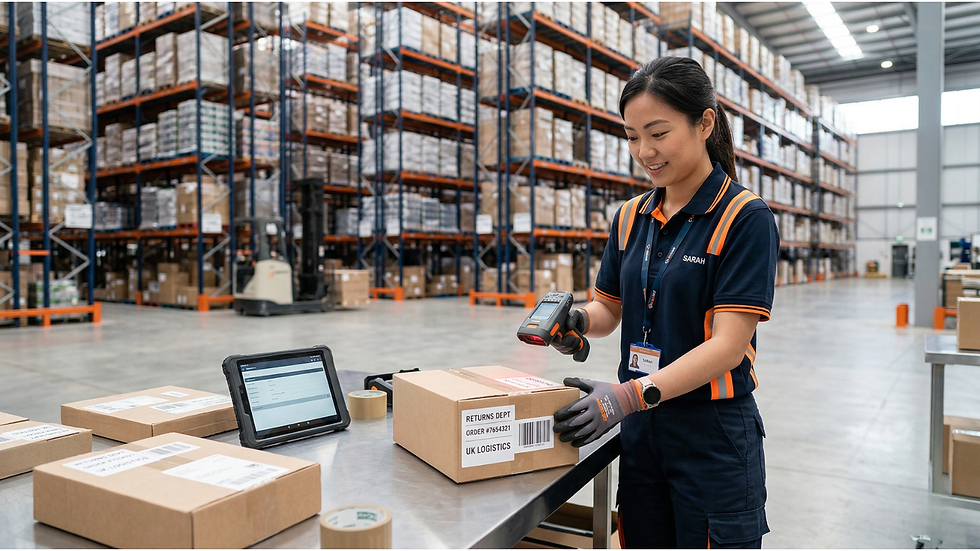
Inbound receiving — Your stock arrives at the warehouse. Each item is checked against the purchase order, inspected for damage, and logged into the warehouse management system (WMS).
Storage and inventory management — Products are scanned and assigned to specific warehouse locations. The WMS tracks every unit in real time, syncing stock levels across all your sales channels to prevent overselling.
Order import — When a customer places an order on your Shopify store, Amazon listing, or eBay shop, it is automatically pulled into the fulfilment system. No manual data entry, no copy-pasting tracking numbers.
Picking — A warehouse operative receives a pick list and collects the correct items from their assigned locations. Modern systems optimise pick paths to reduce errors and speed up the process.
Packing — Items are packed securely for transit, using appropriate packaging for the product type. Some providers offer branded or custom packaging as an added service.
Labelling and dispatch — Shipping labels are generated automatically. The system selects the optimal carrier based on destination, weight, service level, and cost. The parcel is handed to the courier, and a tracking link is sent to the customer.
Returns processing — If a customer returns an item, the fulfilment centre receives it, inspects the product, and either restocks it or flags it for disposal — depending on condition and your instructions.
Each step is tracked digitally. You can see your inventory levels, order progress, and shipment status through a client portal — giving you full visibility without setting foot in a warehouse.
Key point: Professional ecommerce fulfilment is not just about packing boxes faster. It is about building a system that scales with your business, reduces errors, and gives your customers the delivery experience they expect.
How Does a 3PL Fulfilment Provider Work?
A 3PL (third-party logistics) provider is a company that handles warehousing, order processing, and shipping on your behalf. Instead of renting your own warehouse and hiring your own staff, you outsource the entire fulfilment operation to a specialist — while keeping full control over your products and brand.
The UK's 3PL industry generates over £22.2 billion in annual revenue, and a growing share of that comes from ecommerce fulfilment as more online sellers recognise the advantages of outsourcing.
What Happens When You Partner with a 3PL
The process typically works like this:
You send your inventory to the 3PL's warehouse. This can be from your supplier, manufacturer, or an existing storage location.
Your sales channels connect to the 3PL's software. Platforms like Shopify, Amazon, eBay, Etsy, WooCommerce, and Magento integrate directly, so orders flow in automatically.
Orders are fulfilled in real time. As soon as a customer places an order, the 3PL's system triggers picking, packing, and dispatch — often within hours.
You monitor everything remotely. A client portal gives you live updates on stock levels, orders in progress, shipped parcels, and returns.
The Technology Behind It
Modern 3PL providers rely on a warehouse management system (WMS) to coordinate operations. The WMS handles:
Barcode scanning at every stage (receiving, picking, packing, dispatch)
Automated carrier selection — choosing the best courier based on destination, parcel weight, and delivery speed
Real-time inventory synchronisation across all connected sales channels
Automatic shipping label and customs document generation
Low-stock alerts so you can reorder before running out
This technology is what separates a professional 3PL from simply paying someone to pack boxes. It is the infrastructure that ensures accuracy, speed, and visibility — the three things ecommerce customers care about most.
Who Uses 3PL Fulfilment?
3PL is not just for large brands. In the UK, businesses of every size use third-party fulfilment:
Startups launching their first product and wanting to focus on marketing rather than logistics
Growing brands hitting 50-100+ orders per week and running out of space
Established sellers managing multiple channels who need a single fulfilment hub
International brands entering the UK market and needing a local distribution base
In-House vs Outsourced Fulfilment: Which Is Better?
In-house fulfilment means handling everything yourself — renting space, hiring staff, buying packaging, and managing shipping. Outsourced fulfilment means handing those responsibilities to a 3PL provider who does it for you. Both approaches have merits, and the right choice depends on your order volume, growth plans, and how you want to spend your time.
Side-by-Side Comparison
Factor · In-House Fulfilment · Outsourced (3PL) Fulfilment
Upfront cost · High — lease, equipment, staff · Low — pay per order/pallet
Scalability · Limited by your space and team · Scales with demand instantly
Delivery speed · Depends on your setup · Same-day and next-day standard
Technology · You buy and maintain WMS · Included in the service
Accuracy · Manual processes, higher error risk · Barcode-driven, system-checked
Peak handling · Hire temp staff, hope for the best · Provider absorbs volume spikes
Your time · Hours daily on packing and shipping · Freed up for sales and growth
When In-House Makes Sense
If you are shipping fewer than 10-20 orders per week, in-house fulfilment can work well. You know your products intimately, you control every detail of the unboxing experience, and the costs are manageable. For very early-stage businesses, this hands-on approach helps you understand your customers and refine your product.
When Outsourcing Becomes the Smarter Choice
The tipping point usually arrives when logistics starts competing with growth. Signs include:
You are spending more than two hours a day on packing and shipping
Orders are piling up during busy periods and you are missing dispatch cutoffs
You have had to turn down wholesale or marketplace opportunities because you cannot handle the volume
Storage is overflowing — products stacked in hallways, garages, or rented units at rising cost
UK warehouse costs have increased by over 20% since 2020, and warehouse wages have risen by 21% in 2024 alone. For many sellers, the maths now favours outsourcing: a 3PL's variable, per-order pricing often costs less than maintaining your own operation — especially when you factor in the value of your own time.
The real question is not "can I afford a 3PL?" — it is "can I afford to keep doing this myself?"
The shift from in-house to outsourced fulfilment is not about admitting defeat. It is about recognising that your time is better spent on product development, marketing, and customer relationships — the things that actually drive revenue.
What to Look for in a UK Ecommerce Fulfilment Partner
Not all fulfilment providers are the same. Choosing the wrong one can mean late deliveries, inventory errors, and frustrated customers — the exact problems you were trying to solve. Here is what separates a good ecommerce fulfilment partner from a mediocre one.
Platform Integrations
Your fulfilment provider must connect seamlessly with the platforms you sell on. At a minimum, look for native integrations with Shopify, Amazon, eBay, WooCommerce, and any marketplace you plan to expand into. The integration should be automatic — orders flowing in without manual entry, stock levels syncing in real time across every channel.
If you are managing multiple sales channels, this is non-negotiable. Manual order processing leads to overselling, delays, and mistakes.
Delivery Speed and Options
UK customers now expect next-day delivery as standard. But what about same-day? Not every 3PL can offer it — many rely entirely on third-party courier networks with fixed cutoff times.
Providers with in-house courier capabilities can offer faster, more flexible dispatch options. This matters especially during peak periods when courier networks are under strain.
Scalability Without Lock-In
Your fulfilment partner should grow with you — not hold you back. Ask these questions:
Is there a minimum order volume? (Some providers require 150+ orders per month)
Can they handle sudden spikes — a viral TikTok post, a flash sale, Black Friday?
Do you pay only for what you use, or are there fixed monthly fees regardless of volume?
The best providers offer a pay-as-you-go model with no minimums, making them accessible from day one.
Real-Time Visibility
You should never have to ring your fulfilment partner to ask where an order is. Look for a client portal that gives you:
Live inventory levels across all SKUs
Order status from placement through to delivery
Inbound shipment tracking
Downloadable reports for accounting and forecasting
Transparency is not a luxury — it is the foundation of trust between you and your fulfilment partner.
Returns Handling
Returns are a fact of ecommerce life. A good fulfilment provider manages the entire reverse logistics process: receiving returned items, inspecting them, restocking where appropriate, and updating your inventory automatically. Without this, returns become a time drain that pulls you back into the warehouse.
Location
A centrally located warehouse means faster, cheaper deliveries to more of the UK. Fulfilment centres in Manchester, the Midlands, or Yorkshire can typically reach the entire country within a next-day delivery window — keeping your customers happy and your shipping costs under control.
MBL Fulfilment, for example, operates from a Manchester hub with same-day dispatch capability, full platform integrations (Shopify, Amazon, eBay, Etsy, WooCommerce, Magento), and no minimum order requirements — combining the flexibility startups need with the infrastructure established brands demand.
How Much Does Ecommerce Fulfilment Cost in the UK?
Ecommerce fulfilment pricing in the UK typically follows a variable, per-use model — you pay for the storage space you occupy, the orders you ship, and any additional services you use. There are no universal rates, but understanding the pricing structure helps you compare providers and budget accurately.
Typical 3PL Pricing Components
Cost Type · What It Covers · Typical Range
Storage fees · Per pallet, per shelf, or per cubic metre per week · £2.50–£6.00 per pallet/week
Pick and pack · Per order: picking items + packing for dispatch · £1.00–£3.50 per order
Additional item fee · Extra charge for each item beyond the first in a multi-item order · £0.30–£0.75 per item
Shipping · Carrier cost, varies by weight, size, and destination · From £2.50 (UK standard)
Inbound receiving · Checking and logging your stock into the warehouse · Often per pallet or per hour
Value-added services · Kitting, quality checks, custom packaging, labelling · Quoted per project
Most providers offer transparent pricing sheets. If a fulfilment company cannot give you a clear breakdown of costs before you commit, that is a red flag.
The Hidden Costs of Doing It Yourself
When comparing 3PL pricing to your current setup, it is easy to focus only on the per-order fee. But self-fulfilment carries costs that are often invisible:
Warehouse or storage rent — even a small unit costs £500–£2,000+ per month in most UK regions
Staff wages — hiring even one part-time packer at UK minimum wage adds up quickly, and warehouse wages rose 21% in 2024
Packaging materials — boxes, tape, void fill, labels, branded inserts
Software — shipping label tools, inventory management, multi-channel sync
Equipment — shelving, scales, printers, scanners
Your own time — the most expensive cost of all, yet the easiest to ignore
A common mistake: Sellers compare the 3PL's per-order fee to the cost of a roll of tape and a cardboard box, forgetting the rent, the wages, the software, and the hours they spend doing work that does not grow the business.
Pay-as-You-Go vs Fixed Costs
The key financial advantage of outsourcing is variability. When orders slow down — after Christmas, during a quiet month — your fulfilment costs drop with them. When orders spike, your provider absorbs the volume without you hiring temporary staff or panic-buying packaging.
With in-house fulfilment, your rent, wages, and overheads stay the same whether you ship ten orders or ten thousand.
For growing ecommerce businesses, this flexibility is often the deciding factor.
How Ecommerce Fulfilment Helps You Scale
Growth is the goal of every online business — but growth without the right logistics infrastructure creates chaos. Orders pile up, dispatch times slip, reviews turn negative, and the brand you worked hard to build starts losing credibility. Professional ecommerce fulfilment removes this ceiling.
From Spare Room to Serious Operation
Consider a typical trajectory. You launch a Shopify store, sales pick up, and you are packing 30 orders a week from your kitchen table. Then a product goes viral on social media. Overnight, you are looking at 300 orders — and you have neither the space, the staff, nor the packaging to cope.
With a 3PL partner, that spike is absorbed seamlessly. The warehouse has the stock, the systems process the orders automatically, and the carriers collect as normal. You go from panic to business as usual.
Multi-Channel Without the Chaos
Selling on multiple platforms — Shopify, Amazon, eBay, Etsy — multiplies your revenue potential but also multiplies your logistics complexity. Each channel has its own order flow, its own shipping expectations, and its own inventory count.
A fulfilment provider with proper multi-channel integration consolidates everything into one inventory pool and one dispatch process. Stock levels sync across every platform in real time, eliminating overselling and the manual juggling that comes with managing channels separately.
Peak Season Resilience
Black Friday, Christmas, January sales — these periods can make or break an ecommerce business. The UK's ecommerce fulfilment market is projected to reach $17.3 billion by 2030, driven largely by the seasonal surges that define online retail.
A professional fulfilment partner plans for peaks months in advance. They staff up, allocate additional warehouse space, and extend dispatch cutoff times — so your customers still get their orders on time even when volumes triple.
Focus on What Grows the Business
The most overlooked benefit of outsourcing fulfilment is time. Every hour you spend packing boxes is an hour not spent on:
Developing new products
Running marketing campaigns
Building wholesale relationships
Improving your website and customer experience
Fulfilment is essential, but it is not what makes your brand unique. Partnering with a specialist lets you focus on the work that actually drives revenue — while the logistics run in the background, reliably and accurately.
Common Mistakes When Choosing a Fulfilment Provider
Switching to a 3PL is a significant decision, and the wrong choice can create more problems than it solves. Here are the most common mistakes UK ecommerce sellers make when selecting a fulfilment partner — and how to avoid each one.
1. Choosing Based on Price Alone
The cheapest per-order rate means nothing if accuracy is poor, dispatch is slow, or customer service is non-existent. A provider charging £1.50 per order who ships late and damages products will cost you far more in refunds, returns, and lost customers than a provider charging £2.50 who gets it right every time.
Instead: Compare total value — accuracy rates, delivery speed, technology, and support — not just the price per pick.
2. Ignoring Platform Integrations
If your fulfilment provider cannot connect natively with your sales platforms, you will be stuck manually uploading orders and updating stock levels. This defeats the entire purpose of outsourcing.
Instead: Confirm that the provider integrates directly with every platform you sell on — Shopify, Amazon, eBay, WooCommerce, Etsy, Magento — and that inventory syncs automatically across all channels.
3. Not Asking About Delivery Speed
Many fulfilment providers offer only standard next-day dispatch. That works for routine orders, but what about urgent customer requests, time-sensitive promotions, or last-minute wholesale shipments?
Instead: Ask whether same-day dispatch is available, what the cutoff times are, and whether the provider has its own courier resources or relies entirely on third-party networks.
4. Overlooking the Returns Process
Returns account for a significant portion of ecommerce transactions, particularly in fashion and electronics. If your fulfilment provider has no clear returns process, those items end up in limbo — costing you money and frustrating your customers.
Instead: Ask exactly how returns are received, inspected, and restocked. A good provider treats reverse logistics as a core service, not an afterthought.
5. Skipping the Trial Period
Committing to a long-term contract without testing the service first is risky. Processes look good on paper, but the real test is how the provider performs under actual conditions — your products, your order patterns, your customers.
Instead: Start with a small batch of inventory and a trial period. Evaluate accuracy, speed, communication, and portal usability before scaling up.
6. Forgetting About Scalability
Your business today is not your business in twelve months. A provider that suits you at 100 orders per week may struggle at 1,000 — or worse, may not have the warehouse capacity to store your growing inventory.
Instead: Ask about capacity limits, peak season planning, and whether pricing adjusts favourably as your volume increases.
Frequently Asked Questions
What exactly does an ecommerce fulfilment company do?
An ecommerce fulfilment company stores your inventory, picks and packs orders as they come in, and ships them to your customers. Most providers also handle returns, manage stock levels in real time, and integrate with platforms like Shopify and Amazon so orders flow automatically — removing the need for manual processing on your end.
How much does ecommerce fulfilment cost in the UK?
Costs vary by provider but typically include storage fees (£2.50–£6 per pallet per week), a pick-and-pack fee (£1–£3.50 per order), and shipping charges based on parcel weight and destination. Most 3PLs use a pay-as-you-go model, so you only pay for what you use — with no large upfront investment.
Do I need a minimum number of orders to use a fulfilment service?
Not always. Some providers require 100–150+ orders per month, but others — including MBL Fulfilment — have no minimum order requirements, making the service accessible to startups and small businesses from day one.
How fast can my orders be shipped?
Most UK fulfilment providers offer next-day dispatch as standard, with same-day options available from select providers. Dispatch speed depends on the provider's cutoff time, carrier partnerships, and whether they operate their own courier fleet. Same-day delivery is the fastest-growing segment in UK logistics, growing at 9.6% annually.
Can I use a fulfilment service if I sell on Shopify?
Yes. Most professional fulfilment providers offer direct Shopify integration, along with Amazon, eBay, Etsy, WooCommerce, and Magento. Orders sync automatically, inventory updates in real time, and tracking information is pushed back to your store — giving your customers full visibility on their delivery.
What happens if a customer returns an item?
A good fulfilment provider handles the entire returns process. The returned item is received at the warehouse, inspected against your return policy, and either restocked into inventory or set aside for disposal. Your stock levels update automatically, and the return is logged in your client portal for full traceability.
Is outsourced fulfilment only for large businesses?
No. While 3PL services were once associated with enterprise-level operations, the UK fulfilment market now caters to businesses of all sizes. The UK ecommerce fulfilment market is valued at $7.5 billion and projected to reach $17.3 billion by 2030 — driven in part by small and medium-sized sellers outsourcing for the first time.
Take the Next Step with Ecommerce Fulfilment
Ecommerce fulfilment is not a luxury reserved for big brands with enormous budgets. It is an accessible, practical solution for any online seller who wants to stop spending their time on packing tape and shipping labels — and start spending it on growing their business.
Here is what this guide has covered:
What ecommerce fulfilment is and how the process works from receiving stock to delivering orders
How 3PL providers operate using technology to automate picking, packing, and shipping
The real costs of outsourcing versus doing it yourself — and why variable pricing often wins
What to look for in a UK fulfilment partner, from integrations to delivery speed
Mistakes to avoid when making the switch, including ignoring scalability and choosing on price alone
If you are at the point where logistics is holding your business back — orders are late, stock management is chaotic, or you simply do not have enough hours in the day — outsourcing to a specialist fulfilment partner could be the shift that unlocks your next stage of growth.
MBL Fulfilment was built for exactly this. As part of an established logistics group with courier heritage dating back to 2009, MBL combines operational experience with enterprise-grade technology — offering same-day dispatch, real-time inventory visibility, seamless multi-channel integration, and no minimum order volumes. Whether you are shipping your first ten orders or your first ten thousand, the infrastructure is ready.
Your products. Our responsibility. Your customers. Our priority.
Get in touch for a free consultation and find out how outsourcing your fulfilment can give you the time, accuracy, and scalability your business needs to thrive.


Comments