.png)
.png)
Ecommerce Fulfilment Returns: How to Stop Losing Money on Every Return
- Adam

- 7 days ago
- 12 min read
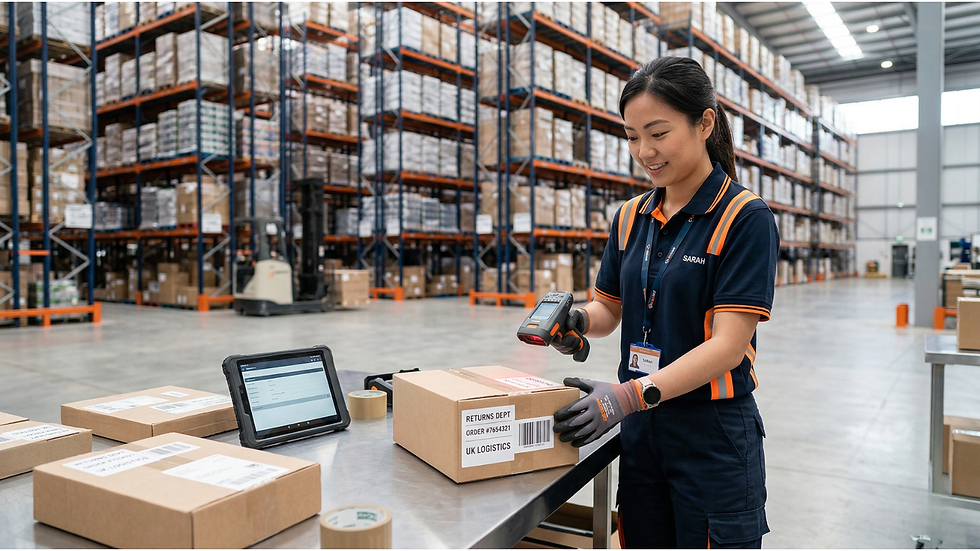
The Ecommerce Fulfilment Returns Problem Nobody Talks About
You spend money acquiring a customer. You pick the order, pack it, ship it. The customer opens the parcel — and sends it back.
That return now costs you again. Processing. Inspection. Repackaging. Re-shelving. Or worse — writing it off entirely.
For UK ecommerce businesses, this is not an edge case. It is the norm. Return rates in fashion run at 20–30%. In electronics, higher. In the run-up to Christmas, some categories see returns exceeding 40% of orders shipped.
The broader picture is stark: UK consumers returned an estimated £6.6 billion worth of online purchases in 2024, according to data from the Centre for Retail Research. That figure is rising year on year.
The problem is not that customers return things. The problem is that most ecommerce businesses have no system for handling it efficiently. Returns arrive at the wrong address. Stock sits uninspected for weeks. Items that could be resold are written off because nobody has time to check them.
This is where ecommerce fulfilment returns management changes the equation. When returns are integrated into your fulfilment operation — not bolted on as an afterthought — they stop being a pure cost and start becoming a recoverable asset.
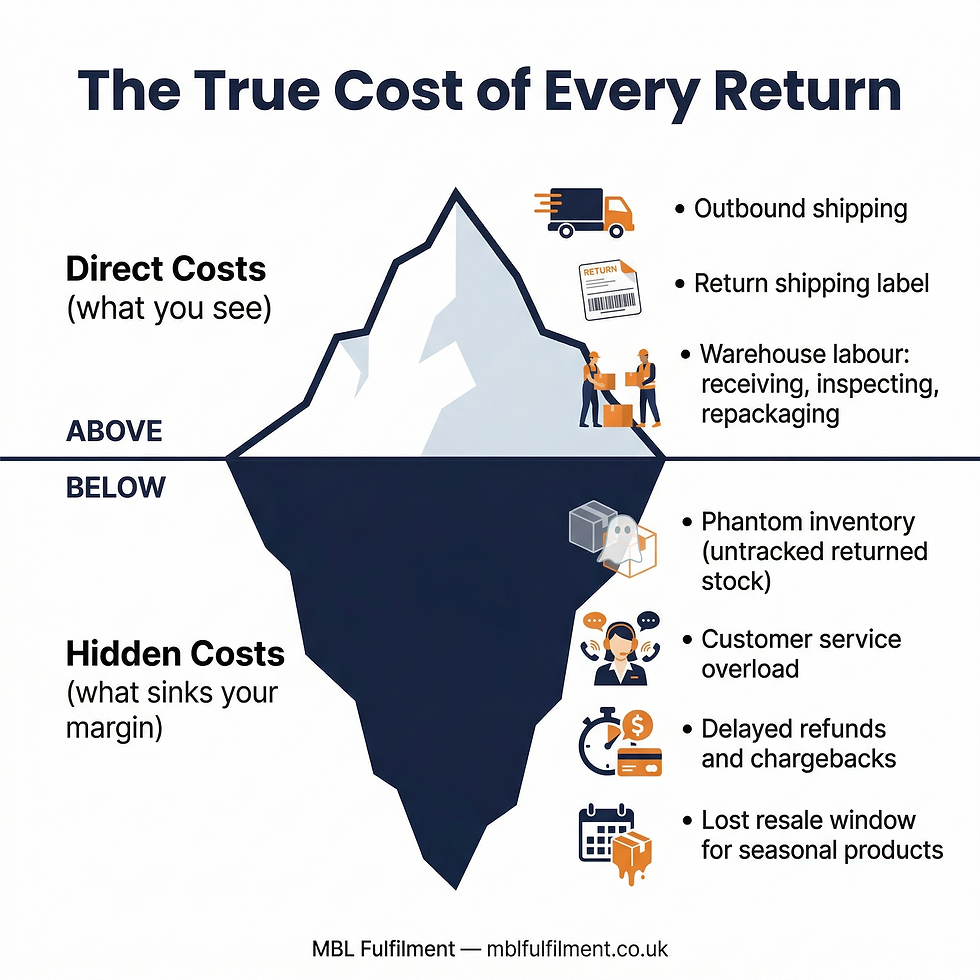
What Does a Return Actually Cost You?
Most ecommerce sellers underestimate the true cost of a return because they only count the obvious expenses. The full picture is considerably worse.
Direct costs:
Outbound shipping (already spent, non-recoverable)
Return shipping label (often seller-funded)
Warehouse labour: receiving, inspecting, sorting, repackaging
Re-listing or disposal if the item cannot be resold
Hidden costs:
Inventory inaccuracy — returned stock that hasn't been inspected or re-shelved creates phantom inventory
Customer service time — returns generate queries, complaints, and refund requests
Delayed refunds — slow returns processing leads to chargebacks and negative reviews
Lost resale window — seasonal or trend-sensitive stock written off because processing took too long
Industry estimates put the average cost of processing a single return in UK ecommerce at between £8 and £20, depending on the product category and the seller's setup. For a business shipping 500 orders a month with a 20% return rate, that is 100 returns — costing between £800 and £2,000 every month, before you account for the value of stock that cannot be resold.
The businesses that manage this best are not the ones that somehow generate fewer returns. They are the ones whose ecommerce fulfilment operation handles returns fast, accurately, and cheaply enough that the net cost per return stays low.
Why Most Self-Managed Returns Fail
For businesses handling their own fulfilment — from a home, a unit, or a small warehouse — returns management is almost always the weakest link. The reasons are predictable.
No dedicated process. Outbound orders have a workflow: pick, pack, label, ship. Returns rarely have the equivalent. Parcels arrive, get stacked in a corner, and are dealt with "when there's time." There is never time.
No grading system. Is this item resellable as new? Does it need repackaging? Is it damaged beyond use? Without a consistent grading process, these decisions are made inconsistently — and stock that could be resold gets written off, while damaged stock gets accidentally relisted.
No returns address management. Some businesses inadvertently list their home address on return labels. Others use a courier depot that doesn't forward parcels. Getting returns to the right place, quickly, requires infrastructure most small operations don't have.
No platform integration. When a return arrives, does your Shopify or Amazon inventory update automatically? For most self-managed operations, it doesn't. Stock levels drift out of sync. You either oversell — and disappoint customers — or artificially suppress listings to compensate, leaving money on the table.
No reporting. Which products are returned most often? What are the stated reasons? Without this data, you cannot have the conversation with your supplier or review your product listings to reduce the return rate upstream.
These are not problems that require more effort to solve. They require a different infrastructure — one that is purpose-built for high-volume returns management as part of the broader ecommerce fulfilment operation.
What Integrated Ecommerce Fulfilment Returns Management Actually Looks Like
When returns management is built into your ecommerce fulfilment operation rather than managed separately, the process looks fundamentally different.
A single returns address. Your customers return everything to the fulfilment warehouse — not to a carrier depot, not to your home. The warehouse is set up to receive returns as part of its daily workflow.
Fast intake and inspection. Returns are booked in, opened, inspected, and graded against consistent criteria — typically within 24 to 48 hours of arrival. Each item is assessed: resellable as new, resellable with repackaging, requires repair, or unsellable. This decision is made at the point of intake, not weeks later.
Automatic inventory updates. When a return is graded as resellable, it goes back into live inventory immediately — and the platform integration updates your Shopify, WooCommerce, Amazon, or eBay stock count in real time. There is no gap between the item arriving back at the warehouse and it being available to sell again.
Restocking, repackaging, and disposal. Items that need new packaging are repackaged before restocking. Items that cannot be resold are either disposed of, donated, or returned to your supplier — based on rules you set in advance. Nothing sits in limbo.
Returns data fed back to you. A good ecommerce fulfilment partner gives you visibility into your returns: volumes by SKU, reasons by category, processing times. This data is what allows you to spot patterns — a sizing issue, a fragile component, a misleading product image — and fix them upstream.
Customer-facing returns portal. Some 3PL providers support branded returns portals, where customers initiate their return online, print a prepaid label, and track the status of their refund. This removes the "where is my refund?" query from your customer service queue entirely.
This is not a theoretical ideal. It is what well-run ecommerce fulfilment operations deliver as standard.
The Role of Reverse Logistics in UK Ecommerce
Reverse logistics is the supply chain in reverse — the movement of goods from customer back to seller, and everything that happens to them along the way. It is a discipline in its own right, and one that UK ecommerce businesses are increasingly being forced to take seriously.
The Consumer Rights Act 2015 gives UK shoppers a statutory 14-day right to return most online purchases for any reason, with a further 14 days to send items back after notifying the retailer. In practice, many retailers extend this to 28 or even 90 days as a competitive differentiator. That window creates a long tail of returns that can arrive weeks after the original order — making forecasting and warehouse space planning genuinely complex.
Post-Brexit, cross-border reverse logistics has added another layer of difficulty. Returns from EU customers to UK-based warehouses now involve customs declarations, duty reclaim processes, and additional carrier documentation. For businesses selling into Europe from a UK fulfilment base, this is a significant operational overhead that most self-managed operations are not equipped to handle.
The businesses managing this well share a common characteristic: they treat reverse logistics as a core function of their ecommerce fulfilment operation, not as an exception. They have carrier agreements that include competitive return rates. They have warehouse processes designed for inbound returns, not just outbound orders. And they have platform integrations that close the loop between a customer initiating a return and a SKU being back in live inventory.
For businesses working with a 3PL, these capabilities come built in — rather than having to be built from scratch.
Returns Management by Sector: Where the Differences Matter
Returns are not the same across all product categories. The economics, the timelines, and the processes involved vary significantly — and your ecommerce fulfilment partner needs to understand the specifics of your sector.
Fashion and apparel
The highest return rates in UK ecommerce — routinely 25–40% — driven by sizing uncertainty and bracket buying (ordering multiple sizes, keeping one). Returns in this category need fast grading and repackaging capability: steaming, refolding, retagging, and rebagging. Items that miss a seasonal window cannot be resold at full price. Speed of processing directly affects margin recovery.
Electronics and tech
Lower return rates but higher complexity. Each returned item typically needs functional testing before it can be resold. Packaging matters more — electronics returned in damaged boxes often cannot be listed as new. Serialised items need to be checked against records. This category benefits most from a grading system with clear resale tiers: sealed, opened/tested, refurbished.
Health, beauty, and wellness
Strict regulatory requirements around returns. Many products — particularly anything applied to skin or consumed — cannot legally be resold once opened. Returns processing in this category is largely about disposal, supplier returns, and accurate write-offs rather than restocking. Batch and expiry tracking adds complexity.
Toys, gifts, and homeware
Often seasonal, which makes the timing of returns critical. A toy returned in January may have missed its peak resale window. Packaging damage is common and often makes an otherwise functional item unsellable at full price. Kitting and repackaging capability is essential.
Subscription boxes
Returns are rarer but more complex when they occur — the contents are bundled, so a partial return requires unpicking a kitted order. The bigger returns management challenge for subscription businesses is failed deliveries and undeliverable parcels, which need to be turned around and reshipped or cancelled quickly to avoid subscriber churn.
A 3PL with experience across these categories will apply the right process to the right product — rather than applying a single generic returns workflow to everything.
How Platform Integration Makes Returns Management Scalable
The single biggest operational risk in returns management is the gap between a physical item arriving back at the warehouse and that event being recorded in your system. Every hour that gap exists, your inventory is wrong.
This is where platform integration — the same technology that automates outbound order flow — becomes equally critical on the inbound side.
When your ecommerce fulfilment operation is fully integrated with your sales channels, the returns workflow is closed-loop:
Customer initiates return via your platform or returns portal
Return is pre-registered in the system before it physically arrives
Warehouse scans the item on arrival — status updates to "received"
After inspection, grading updates the item status: resellable, repackage, or write-off
If resellable — inventory count updates automatically across all connected channels
Refund or exchange is triggered based on pre-set rules

Without integration, every one of those steps is manual. Someone has to check the return against an order, update a spreadsheet, log into Shopify and adjust the stock count, then manually issue the refund. With 10 returns a week, this is inconvenient. With 100, it becomes a full-time job. With 500, it breaks.
As part of the Diamond Logistics partner network, MBL Fulfilment has access to logistics management software that connects to over 16 ecommerce platforms — including Shopify, WooCommerce, Magento, Amazon, eBay, and TikTok Shop. This means returns data flows through the same integration layer as outbound orders, keeping inventory accurate across every channel you sell on.
If you want to understand the full scope of what platform integration means for ecommerce fulfilment, our guide to ecommerce fulfilment integrations covers this in detail.
What to Look for in a 3PL Returns Policy
Not all 3PL providers handle returns equally. Before outsourcing your ecommerce fulfilment to a third-party logistics partner, ask specific questions about how they manage the returns process.
1. What is the returns intake SLA?
How quickly does the 3PL book in a returned item after it arrives at the warehouse? 24 hours is good. 48 hours is acceptable. Anything longer starts to hurt your inventory accuracy and customer satisfaction.
2. What grading system do they use?
Can they apply your grading criteria — not just their own defaults? A fashion brand's definition of "resellable as new" is different from an electronics seller's. The 3PL should be able to configure the grading process to your product type.
3. Can they repackage returned items?
Items that arrive back without original packaging, or with minor cosmetic damage, can often still be resold — if someone repackages them correctly. Ask whether the 3PL offers repackaging as part of the returns service, and at what cost.
4. How are returns integrated with your platforms?
Does a returned and restocked item automatically update your Shopify inventory? Your Amazon listing? Or do you have to do this manually? This is a non-negotiable for any business with significant return volumes.
5. What happens to unsellable stock?
Can the 3PL arrange disposal, donation, or return to your supplier? The last thing you want is unsellable stock accumulating at your 3PL's warehouse, accruing storage fees.
6. Can you access returns reporting?
Return reason data, return rates by SKU, average processing times — this is the intelligence that allows you to reduce returns upstream. If a 3PL cannot provide it, you are missing half the value of outsourced returns management.
7. Do they offer a branded returns portal?
Some 3PLs support white-label returns portals where customers can initiate returns under your brand. This removes friction from the customer experience and reduces inbound customer service queries significantly.
These are not premium extras. They are the baseline of what a capable ecommerce fulfilment partner should offer on returns.
The Carrier Side of Returns: Getting Stock Back Faster
Returns management is not just a warehouse problem. It is also a carrier problem. How quickly a returned item arrives back at your fulfilment centre depends heavily on the return shipping method offered to customers — and the carrier agreements your 3PL has in place.
Prepaid return labels
Offering a prepaid label removes friction for the customer and makes it significantly more likely they will return the item promptly rather than sitting on it for weeks. The faster the return arrives, the faster the stock is back in inventory.
QR code returns
Several major carriers — including Royal Mail and Evri — now support QR code returns, where customers present a QR code at a drop-off point without needing to print a label. Adoption rates for QR code returns are significantly higher than for label-based returns, particularly among younger consumers.
Carrier consolidation
A 3PL working with multiple carriers can route return shipments through the most cost-effective option based on parcel weight, destination, and service level — rather than being locked into a single carrier's return rates. For businesses with high return volumes, this difference in return shipping cost adds up quickly.
Collection versus drop-off
For high-value or bulky items, home collection is often preferable to expecting customers to take items to a drop-off point. A 3PL with relationships across a broad carrier network can offer this as part of the returns package — useful for furniture, electronics, or large homeware.
MBL Fulfilment works with a network of leading UK carriers including Royal Mail, DPD, DHL, and Evri — the same carrier relationships that power outbound delivery also support inbound returns routing, keeping costs down and transit times short. For nationwide returns collection at scale, MBL Logistics provides courier services across the UK through a network of over 800 drivers. For same-day critical collection or time-sensitive return movements, MBL Connect provides a dedicated same-day courier service where standard carrier networks are not fast enough.
Reducing Returns at the Source
The best return is the one that never happens. While this guide is about managing returns efficiently, a capable ecommerce fulfilment partner also helps you reduce return rates upstream — by feeding data back into the decisions that drive them.
Product listings
The most common driver of returns in fashion and electronics is expectation mismatch: the product does not look, feel, or function the way the customer expected from the listing. Returns data by SKU — particularly when combined with the stated reason — points directly at which listings need better photography, more accurate sizing guides, or clearer specification descriptions.
Packaging
A significant proportion of returns arrive damaged — not because the product was faulty, but because the packaging failed in transit. If your 3PL is processing large volumes of returns in a specific category and seeing consistent damage patterns, that is information worth acting on. Better void fill, sturdier outer packaging, or a different box size can eliminate a category of returns entirely.
Carrier performance
Not all damage happens in the warehouse. If returns in a specific courier zone show a pattern of transit damage, that is a conversation to have with the carrier — or a reason to route shipments differently. A 3PL with multi-carrier capability has the leverage to do this; a business locked into a single carrier does not.
Sizing and fit data
For fashion brands specifically, return reason data is some of the most valuable customer feedback available. If 60% of returns on a specific SKU cite "too small," that is a product development signal, not just a logistics problem.
Outsourcing your ecommerce fulfilment to a partner with integrated returns management does not just make the returns process cheaper. It gives you the data to make it rarer.
How MBL Fulfilment Handles Ecommerce Fulfilment Returns
Returns management is a core part of the ecommerce fulfilment service at MBL Fulfilment. It is not a separate product or an add-on — it is built into how we run the warehouse operation.
When a return arrives at our facility in Eccles, Manchester, it is processed against a clear workflow: booked in, inspected, graded, and either restocked or set aside for disposal or supplier return — based on criteria agreed with you in advance. Stock that is cleared for resale goes back into live inventory, with platform integrations updating your connected sales channels automatically.
We work across a wide range of product categories — fashion, beauty, electronics, toys and gifts, food and beverage — and we apply the right grading and handling process to each. Items that need repackaging before restocking are repackaged. Items that need disposal are disposed of cleanly, with a record kept for your accounts.
Our carrier network — Royal Mail, DPD, DHL, Evri, and others — means return shipments are routed efficiently and cost-effectively. For time-critical return movements, we work alongside MBL Connect, our same-day dedicated courier service.
Returns reporting is available through your account: volumes by SKU, processing times, grading outcomes. This is the data that helps you reduce return rates over time, not just manage them.
If your current ecommerce fulfilment setup is making returns harder than it needs to be — for you or for your customers — we would be glad to talk through how we can help. Request a quote or call us on 01614101073.
Sources
Wikipedia — Reverse logistics
Wikipedia — E-commerce
Wikipedia — Third-party logistics
Centre for Retail Research — Online Retailing: Britain, Europe, US and Canada 2024
UK Government — Consumer Rights Act 2015
Citizens Advice — Returning faulty goods
Royal Mail — Returns solutions for retailers
MBL Fulfilment — eCommerce Fulfilment Services
Statista — E-commerce returns rate United Kingdom


Comments